Technology, education and the future, led by Politehnica University Timișoara

Technology, education and the future, led by Politehnica University Timișoara

There's a moment at Davos every year when the real conversation happens – not on stage, but in the corridors, over coffee, between the people who move capital and shape policy. This year, that conversation had one recurring theme: “the window is closing.” Not for the world. For Europe. And if you weren't paying attention, you might have missed just how urgent it sounded.
Davos 2025 opened under the theme "Collaboration for the Intelligent Age," which sounds hopeful enough. But strip away the rhetoric and the message were blunt: while the United States and Asia are sprinting ahead in AI, advanced manufacturing, and digital infrastructure, Europe is debating the rules of a race it's already falling behind in.
The numbers aren't dramatic. They're devastating.
Europe needs roughly €800 billion a year – somewhere between 4 and 5 percent of the EU's GDP – just to stay competitive in AI, green technologies, and defense. Between 2008 and 2021, nearly a third of European startups valued above $1 billion quietly relocated to the United States. The GDP gap between Europe and America, already significant in 2002, has widened by three percentage points since then. And of the world's top 50 technology companies, only four are European.
These aren't predictions. They're the present tense.
The forum added its own layer of urgency: roughly 39 percent of the skills the workforce relies on today will be obsolete within five years. The digital economy already accounts for 15.5 percent of global GDP. And 70 percent of future economic value, according to current projections, will flow through digital platforms.
The real question isn’t whether Europe is in trouble, but which countries are prepared to act – and how. That’s where Mario Draghi comes in, with a plan already on the table.
Mario Draghi doesn't do appearances. He does interventions.
The man who kept the eurozone alive during its worst financial crisis with three words – ‘whatever it takes’ – has spent the last two years doing something equally consequential, though quieter. As the architect of the European Commission's competitiveness strategy, he produced what is arguably the most important economic blueprint Europe has seen in a generation. It's not theoretical. It's not aspirational. It's a roadmap, and it has teeth.
Now he's bringing it to Timișoara.
On May 15, 2026, Draghi will appear as the special guest at “Tech Talks by UPT” – and for anyone still wondering whether this is a ceremonial gesture, it isn't. Draghi recently received the Charlemagne Prize, which places him at the center of the European conversation right now. He doesn't accept invitations to be seen. He accepts them where he believes something real can happen. The fact that he chose Timișoara tells you everything you need to know about how seriously this moment is being taken.
Beneath the noise of Davos, three conclusions kept surfacing. Each one lands differently when you hold it up against Romania's actual situation. First: AI is no longer the future. It's infrastructure. The conversation at Davos didn't revolve around whether companies should "adopt" AI. It revolved around how fast they could rebuild their entire business model around it. Experimentation is over. Implementation is the only game left.
Second: People still beat technology. For all the breathless talk about artificial intelligence, robotics, and quantum computing, the consensus among the people who deploy these tools was surprisingly human. Judgment. Leadership. Ethics. Creativity. The ability to make decisions when the data runs out. Technology without people to wield it becomes sterile – and the leaders who understand this will be the ones who win.
Third: Europe's single market is broken from the inside. This one doesn't get enough attention. Draghi's report documented internal barriers that translate into an effective tariff of 45 percent on goods and 110 percent on services. To put that in concrete terms: it is genuinely easier for a Chinese company to sell across the entire European Union than it is for a Romanian company to sell in Germany.
That last point is the one that should keep Romanian strategists up at night. Romania: massively underrated, dangerously underutilized Here's what's strange about the Davos conversation: Eastern Europe barely came up. And yet Romania sits on one of the most undervalued strategic positions on the continent.
Over 240,000 IT professionals. Technical universities in Bucharest, Cluj, Timișoara, and Iași that produce engineers at serious scale. A startup ecosystem that attracted roughly €398 million in 2025. A geographic position that connects the EU to major trade corridors. Digital infrastructure that ranks among the best in the world.
These are not minor advantages. They are, in the right hands, transformative ones.
But having assets and having a strategy are two very different things. Romania has spent the better part of two decades being Europe's talented outsourcing hub – technically excellent, organizationally fragmented, and consistently undervalued. The challenge that Davos implicitly posed to countries like Romania is deceptively simple to state and brutally hard to execute: “How do you stop being a supplier of talent and start being a creator of value?”
Drawing from Draghi's framework and the threads that ran through Davos, the path forward isn't mysterious. It's just difficult.
Romania needs to shift from outsourcing to owning. The country is exceptional at execution – but it builds remarkably little intellectual property of its own. That changes, or the talent drain accelerates.
Universities need to stop operating as isolated centers of excellence and start functioning as connected ecosystems. Innovation doesn't happen on islands. It happens at intersections – between research, industry, capital, and policy.
Romania needs to move from consuming AI to building it. Only 17.8 percent of Romanians currently use generative AI, compared to a European average of 32.7 percent. In a decade where AI adoption isn't optional, that gap is a strategic vulnerability. And finally, Romania needs to stop following Europe's regulatory instinct and start leading with experimentation. The EU regulates well but innovates slowly. Romania has the chance – and arguably the need – to become the space where new institutional approaches to AI are tested before they scale across the continent.
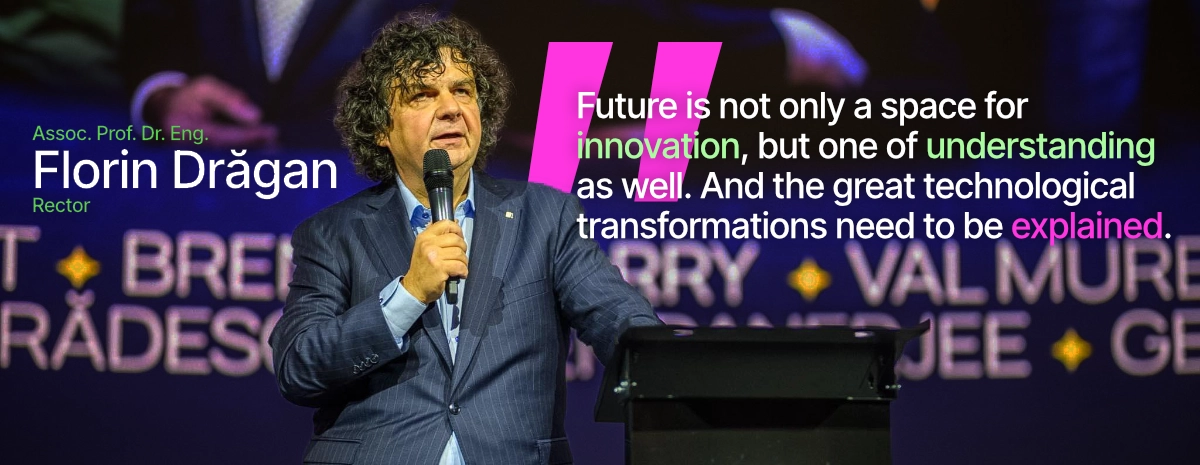
Tech Talks by UPT isn't a conference in the traditional sense. It doesn't exist to generate applause or LinkedIn posts. It exists to close the distance between global strategy and local action.
The way it works is deceptively simple: it brings together the people and institutions that normally operate in silos – universities, industry, venture capital, public policy – and creates the conditions for them to talk to each other. That kind of connectivity, Draghi's report makes clear, is precisely what Europe is missing.
This year's theme – "Irreplaceable – We need humans" – cuts directly to the anxiety that dominated Davos. In an age of AI, what remains human? What can't be automated? The answer, as the theme suggests, isn't defensive. It's competitive. Judgment, strategy, leadership, ethics, creativity – these are not weaknesses in an AI-driven world. They are the new advantages. And Romania, with its deep engineering culture and underexploited creative capacity, is positioned to cultivate exactly these skills.
When Draghi speaks in Timișoara, the room will be full of people who can do something with what he says. That's by design. Tech Talks isn't structured around passive listening. It's structured around follow-through.
The real measure of what happens on May 15 won't be visible until May 16. It will show up in the programs that get launched, the investments that get activated, the university curricula that quietly shift, the research collaborations that start, the startups that form with a clearer sense of where they're going, and – if everything works – the policy conversations that finally move at the speed the moment demands.
Draghi is coming to Timișoara to see potential – and to test whether Romania has the institutional muscle to act on it. This isn't charity. It isn't symbolic. It's a test.
And for the first time in a long while, Romania – through Tech Talks, through UPT, through the quiet work that's been building in Timișoara – is starting to look less like a spectator at Europe's strategic table and more like a player at it.
The only question left is whether we're ready to play.
Tech Talks by UPT 2026 - Irreplaceable: We need humans
May 15, 2026 · Timișoara, Romania
Special guest: Mario Draghi